
What is Karakami?
A Japanese decorative paper with over a thousand years of history
Karakami (唐紙) is a traditional decorative paper whose story in Japan stretches back more than a thousand years.
Its roots can be traced to Japan’s early encounters with the culture of Tang-dynasty China. During the Nara period (710–794), objects, techniques and artistic influences from the continent reached Japan through diplomatic missions and cultural exchange.
Decorative papers brought from China came to be known as karakami — literally, “Chinese paper”.
From imported paper to a Japanese art
During the Heian period (794–1185), decorative paper became closely associated with the refined culture of the Japanese court.
Beautifully patterned papers were treasured as surfaces for calligraphy, poetry and writing. Over time, Japanese papermakers and artisans developed their own techniques and aesthetics, transforming these continental influences into a distinctly Japanese tradition.
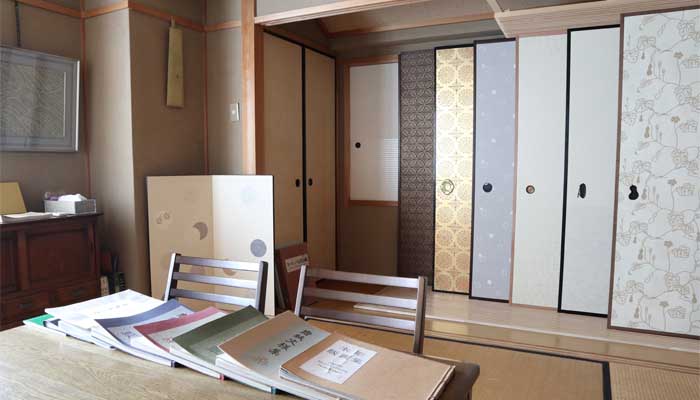
As the craft evolved, Karakami moved beyond the written page and into architecture, adorning fusuma sliding doors, screens and walls in temples, residences and tea rooms.

Printed by hand
Traditional Karakami is created by transferring a pattern from a hand-curved wooden block onto paper.
Pigments — traditionally including kira, a shimmering mineral pigment, and gofun, made from finely ground seashells — are applied to the block. The paper is then placed over it and gently pressed by hand to transfer the design.
Unlike conventional woodblock printing, the impression is made with the palms rather than a baren.
The process is repeated carefully across the paper, aligning the pattern one impression at a time.

The beauty of the handmade
Because every impression is made by hand, no two sheets of Karakami are exactly the same.
The pressure of the artisan's hands, the amount of pigment and the subtle characteristics of the paper create small variations in colour, texture and reflection.
These are not imperfections, but traces of the making process — part of what gives each piece its individual character.
Patterns passed through generations
Waves, clouds, pine trees, chrysanthemums, paulownia, flowing water and geometric forms — Karakami preserves a rich vocabulary of patterns, many inspired by nature and traditional Japanese symbolism.
Some designs have been handed down through generations, their wooden blocks carefully preserved or recreated as they wear with time.
Each pattern carries its own history, meaning and atmosphere.

From Kyoto to contemporary interiors in Europe
For centuries, Karakami has formed part of Japanese architecture, quietly transforming spaces through pattern, texture and light.
At Maison Serendipity, we bring this tradition into contemporary interiors.
Framed as art, created as a large-scale panel or commissioned for a particular space, each piece offers a new way to encounter this centuries-old craft.
A tradition shaped over generations in Japan — and a piece made to begin a new story in your home.

